The Missing Step Between Transcription and Trust
Summary: Taira Giang discusses the procedural gap in handling transcripts, highlighting an issue where a customer interview transcript incorrectly attributed a competitor's claim. They suggest a 'transcript approval contract' to ensure accuracy, involving a clear process of ownership, triggers for re-checks, and visible sign-offs. A content team implemented this by tagging transcripts as 'unreviewed' and having call runners verify low-confidence segments. Emphasizing review discipline, they argue that the integration of tools like GPT Transcribe should complement a workflow that ensures human oversight.
When a Transcript Becomes a Liability
A marketing lead I spoke with last quarter described a familiar problem: her team recorded a 40-minute customer interview, ran it through an automated transcription tool, and dropped the output straight into a case study draft. Two weeks later, a customer flagged that the transcript had attributed a competitor's claim to their own product. Nobody had actually read the transcript before it moved downstream. The audio was accurate enough for a quick skim, but nobody had signed off on it as a source of truth.
This is a narrower problem than "transcription accuracy." Most transcription tools, automated or otherwise, produce text that is good enough for search and skimming but not necessarily good enough to quote, cite, or publish without a human checking it against intent. The gap isn't technical — it's procedural. Teams rarely define who is responsible for confirming a transcript is correct before it gets treated as a finished artifact.
Building a Lightweight Approval Contract
The fix isn't a heavier review process. It's a small, explicit agreement — what you might call a transcript approval contract — that travels with the file from the moment it's generated to the moment it's used. In practice, this contract answers three questions before any transcript leaves draft status:
Who owns accuracy? Not "whoever transcribed it," but a named person who listens back to flagged sections and confirms names, numbers, and attributions are correct.
What triggers a re-check? Speaker overlap, background noise, technical jargon, or any segment where the transcript reads awkwardly are reasonable triggers. A blanket "reread everything" rule rarely survives contact with a deadline.
Where does the sign-off live? A single checkbox in the same doc or project tracker where the transcript is stored, so approval status is visible to anyone who might reuse the text later — a content writer, a support agent, a researcher citing a quote.
None of this requires new software. It requires deciding, in advance, that a transcript is a draft until someone with context confirms it, and building that confirmation into the workflow instead of assuming it happens by default.
A Content Team's Workflow in Practice
Here's how one small content team applied this after their own near-miss. They record product demo calls for internal training and occasionally repurpose segments into public tutorials. Their contract looks like this:
Raw audio or video is uploaded to a shared drive with a naming convention that includes the date and speaker list.
A transcript is generated and stored alongside the source file, tagged "unreviewed."
The person who ran the call — not a general editor — listens to any segment the transcript engine flags as low-confidence, plus the opening and closing minutes, where names and context are usually established.
Corrections are made directly in the transcript, and the tag changes to "reviewed by [name], [date]."
Only reviewed transcripts are eligible to be quoted in external content or fed into research summaries.
The entire review step for a 30-minute call typically takes ten to fifteen minutes, concentrated on the parts most likely to matter — not a full re-listen. That's the point: the contract scopes the review instead of leaving it open-ended, which is usually why review steps get skipped in the first place.
Where Tools Fit, and the Review Step That Matters
Generation speed isn't really the bottleneck here — review discipline is. A transcript that comes out fast but sits untagged and unreviewed creates the same risk as one that took longer to produce. What matters more is whether the workflow around the tool makes review visible and unavoidable at the right moment, not whether the tool itself is fast or feature-rich.
This is where a transcription tool becomes a supporting piece rather than the whole solution. According to the product page, GPT Transcribe is described as an AI transcript generator for converting audio and video into searchable text, intended for use cases like captions, notes, and research workflows. Used inside a workflow that includes an explicit approval step, a tool like this removes the manual transcription burden while leaving the accountability question — who confirms this is right before it's used — exactly where it belongs: with a person. You can see how the tool is positioned at GPT Transcribe.
If your team is already generating transcripts regularly, the useful next step isn't necessarily a new tool. It's writing down, in one sentence per project, who approves a transcript before it's quoted, published, or cited — and making that approval visible to everyone who might reuse the text later.
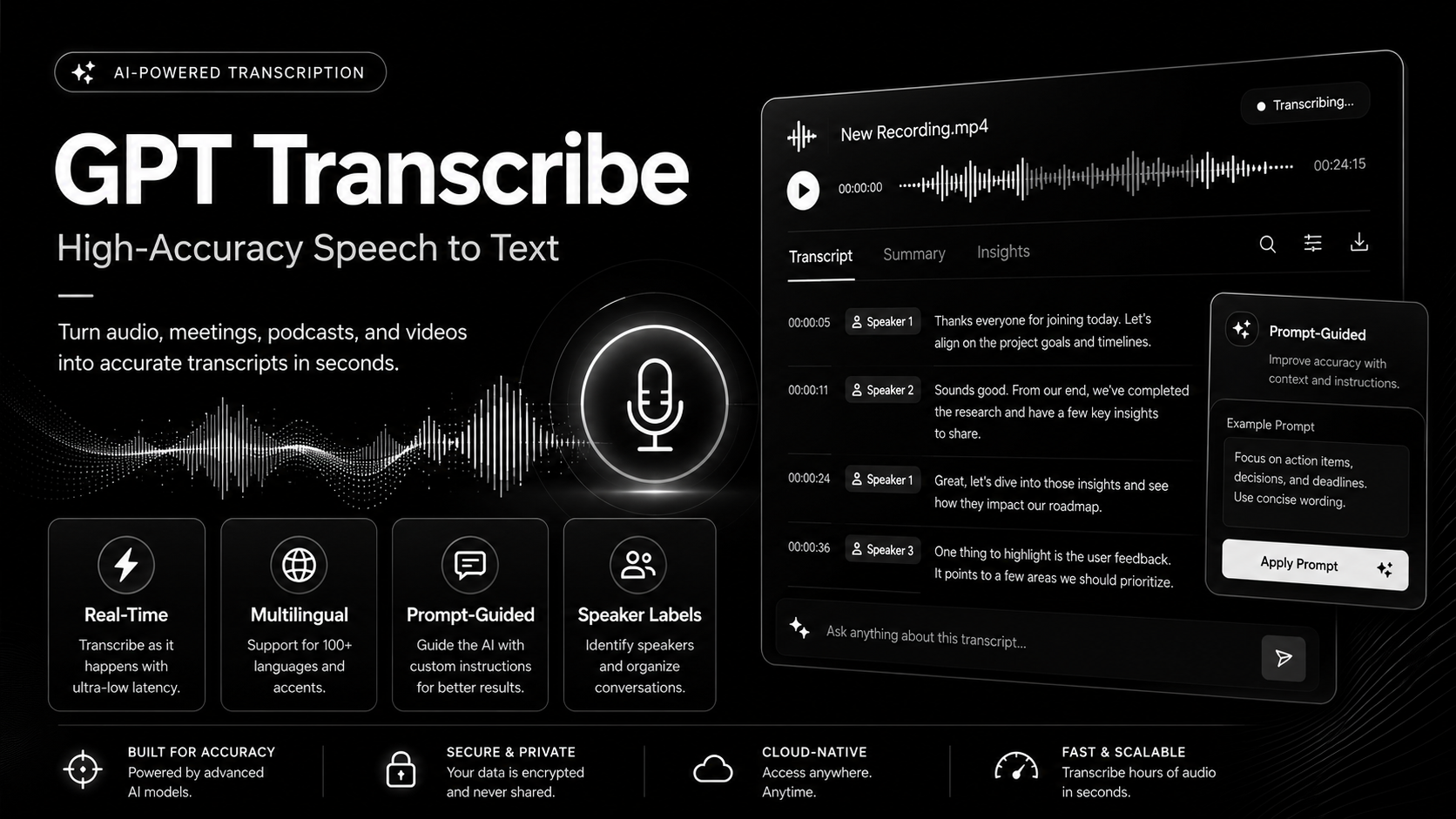
GPT Transcribe official website homepage showing the product interface and primary workflow

.png?_a=BAVMn6DY0)