The Review Bottleneck Nobody Budgets For in Short-Form Video Teams
Summary: Wendy Xu discusses the challenges short-form video teams face in managing fast content production, emphasizing the importance of a review process to track approvals and decisions. They describe how the rapid pace of video generation can lead to confusion without proper documentation, suggesting that teams adopt a review contract to clarify draft status, approvals, and decision evidence. The use of tools like the AI Viral Dance Generator is proposed to streamline initial drafts, allowing teams to focus on reviewing content for tone and brand alignment. The author stresses documenting approval reasons as crucial for maintaining accountability and consistent standards over time.
The Hidden Cost of Fast Content
Most teams that produce short-form video for TikTok, Reels, or Shorts don't struggle with making clips. They struggle with knowing which clip is the right one. A marketer approves a cut on Tuesday, a teammate tweaks the caption on Wednesday, and by Friday nobody can say with confidence which version actually went live or why it was chosen over the other three sitting in a shared folder. This isn't a tooling problem in the usual sense. It's a provenance problem: when output is generated quickly and cheaply, the record of who reviewed what, and on what basis, tends to disappear faster than the content itself.
This matters more as video generation gets faster. A few years ago, producing a short dance or trend-style video meant filming, editing, and exporting — each step naturally left a trail. Now that a single photo or prompt can produce a finished clip in minutes, the trail collapses. Speed removes the friction that used to force a review checkpoint into existence.
What a Review Contract Actually Looks Like
A review contract isn't a legal document. It's a shared, explicit agreement about three things: what counts as a draft, what counts as approved, and what evidence justifies the move from one to the other. For teams working with AI-generated motion content, that usually breaks down into a short set of checks:
Source check: what input (photo, script, template) produced this version, and is that input still accurate or on-brand?
Motion check: does the movement match the intended tone — playful, energetic, restrained — or did the generation drift?
Platform check: is the aspect ratio, length, and pacing appropriate for where it's going (TikTok, Reels, Shorts each reward slightly different rhythms)?
Approval check: who signed off, and is that decision recorded somewhere other than a Slack thread that will scroll away?
None of this requires heavy process. It requires making the implicit explicit, so that when someone asks "why did we publish this one," there's an answer that doesn't rely on memory.
A Concrete Use Case
Consider a small creator-support team helping several clients keep up with trend-driven video formats. Each client wants a steady output of dance-style or movement-based clips tied to whatever is trending that week. The team's actual bottleneck isn't creative — it's throughput and consistency. They need a way to turn a photo into a usable draft quickly, then spend their limited review time on judgment calls rather than production mechanics.
This is where a tool built specifically for this format can fit as one step in a longer chain, not as the whole workflow. According to the product page, the AI Viral Dance Generator lets someone upload a photo, choose a trending dance template, and produce a short video aimed at TikTok, Reels, or Shorts formats. Used this way, it becomes the fast-draft stage: a way to get a motion-based clip in front of a reviewer quickly, so the team's actual work — checking tone, checking brand fit, checking whether the movement matches the trend correctly — can start sooner. The tool produces the draft; the team still owns the decision about what ships.
The Review Step Teams Skip and Regret
The step most teams skip is the simplest one: writing down why a version was approved, not just that it was. "Looks good" is not a review record. "Approved because the movement reads as energetic rather than frantic, and matches last week's format" is. The second version is what lets a new team member, or the same person three weeks later, understand the standard being applied — instead of re-deriving it from scratch every time.
This matters more, not less, as generation gets automated. When a human edits every frame by hand, the reasoning is baked into the labor. When a photo and a template produce a finished clip in minutes, the reasoning has to be added back deliberately, or it simply isn't there. Teams that skip this step don't notice the cost immediately. They notice it three months in, when a client asks why a video was approved and nobody has an answer beyond "someone must have checked it."
Starting Small
You don't need a formal review system to fix this. A shared doc with three columns — source, reviewer, reason — attached to wherever drafts land is enough to start. The goal isn't process for its own sake; it's making sure that speed in production doesn't quietly erase accountability in publishing. If you're evaluating tools for this kind of trend-driven video work, it's worth looking at how a generator like the AI Viral Dance Generator fits into that review habit, rather than treating the tool itself as the finish line.
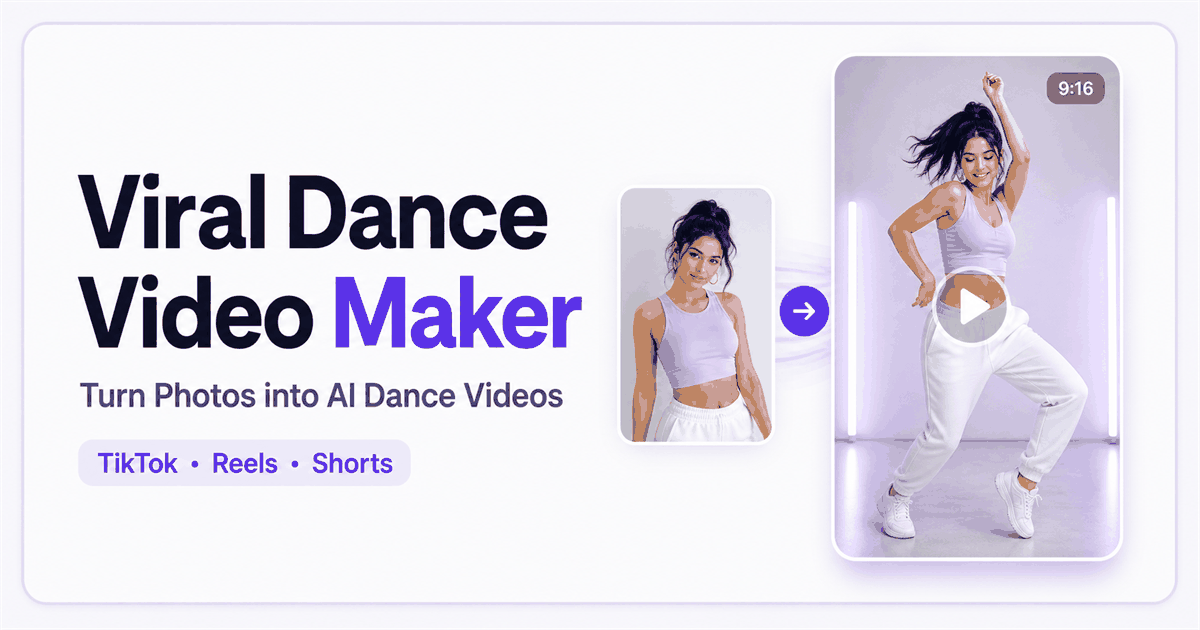
AI Viral Dance Generator official website homepage showing the product interface and primary workflow

.png?_a=BAVMn6DY0)