Why "Generate a Few Options" Breaks Down Without an Acceptance Contract
Summary: Taira Giang discusses the challenges when generating multiple visual design options without a clear acceptance contract. They highlight issues in review meetings where decisions are based on subjective taste rather than specific standards due to the absence of a written guideline. An acceptance contract, according to Taira Giang, should outline specific requirements like text, layout, and style rules to ensure consistency. They suggest using tools like Qwen Image 3.0 to align the generation process with a predefined brief, thus simplifying the review process and avoiding unnecessary debates.
When "Generate a Few Options" Breaks Down
A marketing lead asks for three poster directions by Friday. A product manager asks for a storyboard that covers four user states. In both cases, someone opens an image tool, types a description, and produces a batch of results. The problem shows up later, in the review meeting, when nobody can explain why one version was rejected and another wasn't. The brief said "bold and modern." Every output technically qualifies. The team ends up arguing about taste instead of checking work against a standard, because no standard was ever written down.
This is the same failure mode that shows up in software when a UI change ships without a visual regression baseline. Nobody disagrees that the screen looks different. They disagree about whether the difference is acceptable. Image generation for marketing and product work has the identical gap: outputs vary every time, and without a written contract for what "acceptable" means, every review cycle re-litigates the brief from scratch.
Writing the Acceptance Contract Before You Generate
An acceptance contract, in this context, is a short list written before generation starts, not after. It names the things a reviewer will actually check, in order of how much they cost to fix later:
Exact text strings that must appear correctly, including capitalization, punctuation, and language
Layout regions that must stay fixed (a headline zone, a logo placement, a caption band)
Composition rules such as subject placement, negative space for later text overlay, or aspect ratio
Style boundaries described narrowly enough that a reviewer can point to a specific mismatch, not just say "doesn't feel right"
Multilingual requirements, if the same layout needs to run in more than one language without breaking the grid
The contract doesn't need to be long. It needs to be specific enough that two different reviewers, looking at the same output, would flag the same problems. If the contract says "clear hierarchy between headline and subhead," two people can disagree on how well that's executed. If it says "headline no longer than 6 words, subhead in a secondary weight, both left-aligned in the top third," there's something concrete to check against.
Running the Contract Against a Real Brief
Consider a product team building a multilingual onboarding storyboard: four screens, each needing a short illustration, a headline in English and Spanish, and consistent visual style across all four. Instead of generating loosely and hoping for consistency, the team writes the contract first: subject per screen, exact headline text in both languages, a shared color and line-weight direction, and a fixed layout grid so the four screens read as a set.
This is where a tool like Qwen Image 3.0 fits into the process rather than replacing it. According to the product page, Qwen Image 3.0 is built for generating and editing images from a described subject, exact text, language, composition, and layout, with support for organizing complex requests into clear sections. That structure matters here: the contract's checklist items (exact text, layout, language, style) map directly onto what the tool expects as input. The team isn't asking a generator to guess at "modern and clean" — they're feeding it the same specification a reviewer will later use to accept or reject the output.
The generation step still produces multiple directions. That part doesn't change. What changes is that each direction gets evaluated against a written contract instead of a mood.
What Passes, What Gets Sent Back, and Where the Link Fits
The review step is where the contract earns its cost. Each generated image is checked line by line: Is the exact text correct in both languages? Is the subject placed inside the fixed layout region? Does the line weight match across all four screens? A version that nails the composition but garbles the Spanish text fails, even if it looks appealing. A version with correct text but a shifted layout also fails, because the contract said the grid stays fixed. This turns the review meeting into a checklist exercise instead of a subjective debate, and it gives whoever requested the work a clear reason for every rejection, which speeds up the next round of edits instead of restarting it.
None of this requires a new tool category — it requires treating the brief as a contract and the generation step as one part of a larger workflow, with review criteria written before the first image exists. Teams that skip this step tend to generate more images, not better ones, because every round adds new opinions instead of resolving old ones.
For teams testing this approach, Qwen Image 3.0 is one option for producing and editing images directly from a written brief, which makes it easier to keep the contract and the generation step aligned from the start.
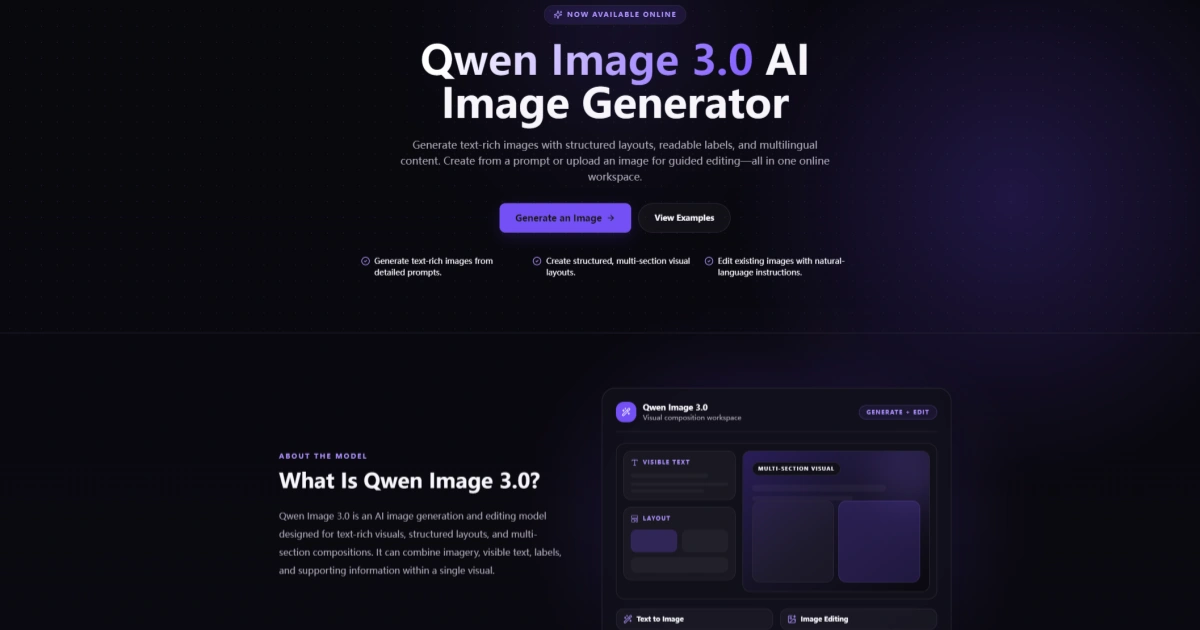
Qwen Image 3.0 official website homepage showing the product interface and primary workflow

.png?_a=BAVMn6E80)